
Breast cancer screening helps detect changes before symptoms appear. Two common imaging tests are a mammogram and a breast MRI. Many people wonder which test is more accurate and which one they should choose. The answer depends on your age, breast density, personal risk, and medical history.
In the Breast MRI vs Mammogram comparison, there is no single winner. A mammogram is the standard screening test for most women. A breast MRI provides more detailed images and is usually recommended for people with a higher risk of breast cancer or dense breast tissue. Understanding the difference can help you discuss the right screening plan with your doctor.
What Is a Mammogram?
A mammogram is a low-dose X-ray of the breast. It is the most common screening test for breast cancer. It can detect small tumors and tiny calcium deposits before they become noticeable.
During the test, each breast is gently compressed between two plates. The scan usually takes about 15 to 20 minutes. Some women feel mild discomfort, but the compression lasts only a few seconds.
Regular mammograms are recommended for women based on their age and individual risk factors. They remain the first choice for routine breast cancer screening.
Learn more about the importance of regular breast screening in our guide on how regular mammograms help detect breast cancer early.
What Is a Breast MRI?
A breast MRI uses a powerful magnetic field and radio waves to create detailed images of breast tissue. Unlike a mammogram, it does not use radiation. Most breast MRI scans require a contrast dye that is injected into a vein before imaging.
The scan usually takes 30 to 45 minutes. You lie face down on a padded table while the machine captures detailed images. A breast MRI can detect abnormalities that may not be visible on a mammogram, especially in dense breast tissue.
Doctors often recommend this test for women with a strong family history of breast cancer, BRCA gene mutations, previous chest radiation, or other high-risk conditions.
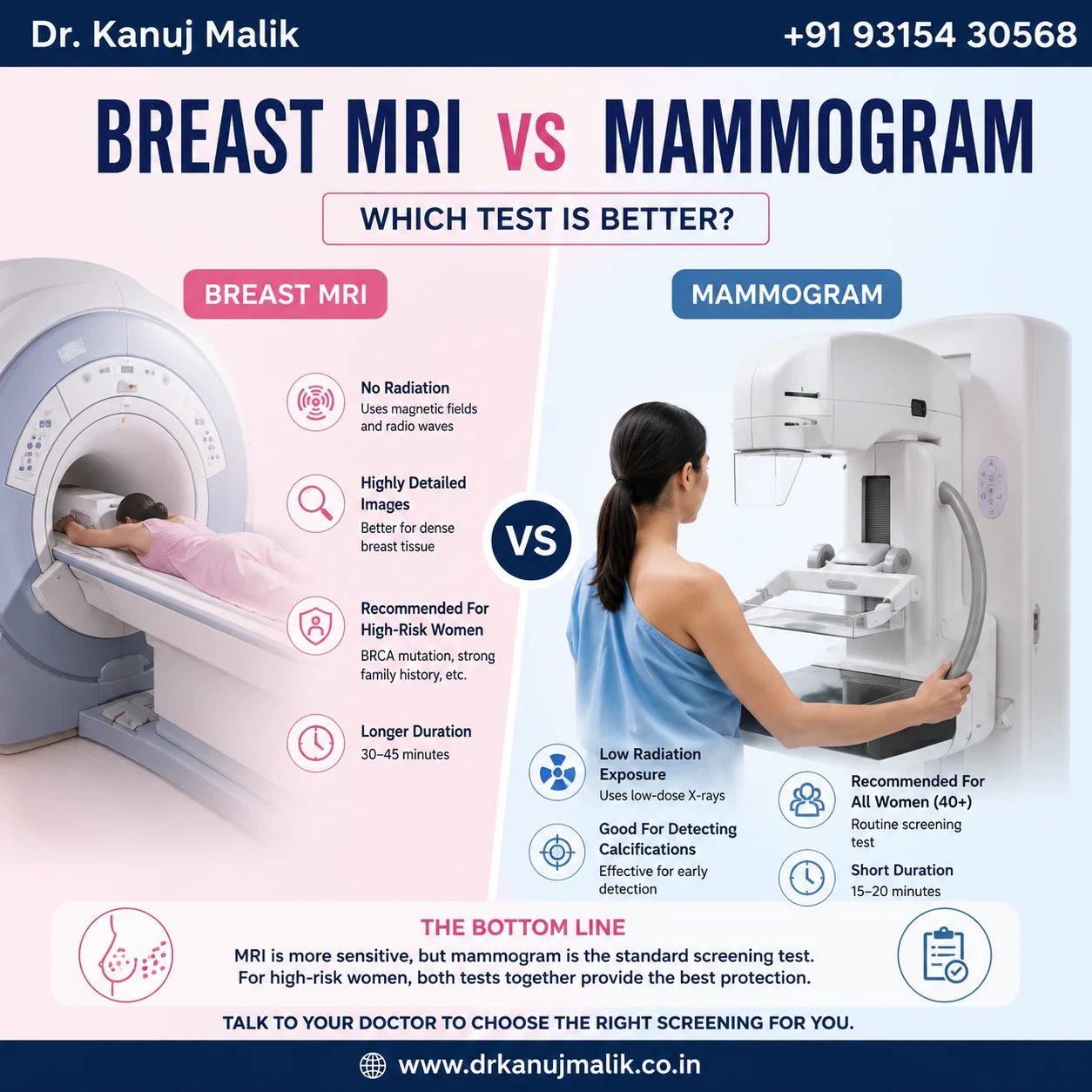
Breast MRI vs Mammogram: Quick Comparison
| Feature | Mammogram | Breast MRI |
|---|---|---|
| Technology | Low-dose X-ray | Magnetic field and radio waves |
| Radiation | Yes | No |
| Contrast Dye | Not required | Usually required |
| Best For | Routine screening | High-risk screening |
| Dense Breast Tissue | Less effective | More effective |
| Test Duration | 15–20 minutes | 30–45 minutes |
| Cost | Lower | Higher |
Which Test Detects Breast Cancer Better?
When comparing Breast MRI vs Mammogram, MRI is generally more sensitive. It can detect some cancers that a mammogram may miss, especially in women with dense breasts. However, a breast MRI can also identify harmless changes that require additional testing. This increases the chance of false-positive results.
A mammogram remains highly effective for routine screening. It is especially good at detecting tiny calcium deposits that may indicate early breast cancer.
Breast MRI vs Mammogram for Dense Breasts
Dense breast tissue can make cancers harder to see on a mammogram because both dense tissue and tumors appear white on X-rays. In these cases, a breast MRI provides clearer images and improves cancer detection.
If you have dense breasts, your doctor may recommend additional imaging based on your overall risk. Read our detailed guide on breast density and mammogram accuracy.
Can You Need Both Tests?
Yes. Some women benefit from both a mammogram and a breast MRI. This is common for people with a BRCA gene mutation, a strong family history of breast cancer, previous chest radiation, or a lifetime breast cancer risk of 20% or higher.
Using both tests provides more complete information. A breast MRI does not replace a mammogram. Instead, it acts as an additional screening tool for selected patients.
If you notice unusual symptoms such as a new lump, nipple changes, or persistent breast pain, seek medical advice promptly. You can also read about the early warning signs of breast cancer.
Pros and Cons of Mammogram and Breast MRI
Mammogram
Advantages
- Recommended for routine breast cancer screening.
- Quick and widely available.
- Lower cost than an MRI.
- Detects tiny calcium deposits linked to early breast cancer.
Limitations
- Uses a small amount of radiation.
- Less accurate in women with dense breast tissue.
- May miss some cancers hidden by dense tissue.
Breast MRI
Advantages
- Produces highly detailed breast images.
- Works well for dense breasts.
- Useful for women with a high risk of breast cancer.
- Does not use radiation.
Limitations
- Costs more than a mammogram.
- Usually requires contrast dye.
- May detect non-cancerous changes that need more tests.
- Not recommended as a routine screening test for everyone.
Breast MRI vs Mammogram: Cost in India
The cost varies by city, hospital, and the technology used. A mammogram is usually more affordable. A breast MRI is more expensive because it uses advanced imaging and often requires contrast material. Your doctor can advise which test is appropriate based on your symptoms and risk factors rather than cost alone.
Are These Tests Safe?
Both tests are considered safe when performed for the right medical reason.
A mammogram uses a very low dose of radiation. The benefits of early cancer detection generally outweigh this small exposure.
A breast MRI does not use radiation. However, most scans require a gadolinium-based contrast dye. People with severe kidney disease or a history of contrast allergy should discuss this with their doctor before the scan.
Which Test Should You Choose?
For most women, a mammogram is the first choice for routine breast cancer screening. A breast MRI is usually recommended for women with dense breasts, BRCA gene mutations, a strong family history of breast cancer, or other high-risk conditions.
The right choice depends on your medical history, age, symptoms, and individual risk. Your doctor may also recommend both tests to improve cancer detection in selected cases.
Frequently Asked Questions
Is a breast MRI more accurate than a mammogram?
A breast MRI is more sensitive and can detect some cancers that a mammogram may not show. However, it can also produce more false-positive results.
Can a breast MRI replace a mammogram?
No. A breast MRI is an additional screening tool for selected patients. It does not replace routine mammograms.
Who should get a breast MRI?
Women with a high lifetime risk of breast cancer, BRCA mutations, previous chest radiation, or very dense breast tissue may benefit from a breast MRI.
Is a mammogram painful?
Some women feel brief discomfort due to breast compression. The test is quick, and the pressure lasts only a few seconds.
Dr. Kanuj Malik
Surgical Oncologist
Phone: 09315430568
Address: Shop No. 143, 1st Floor, Cleo Street, Near Cleo County, Sector 121, Noida, Basi Bahuddin Nagar, Uttar Pradesh 201301
View Clinic Location on Google Maps
To learn more about Dr. Kanuj Malik’s experience, visit the doctor profile.
If you have concerns about breast cancer risk or need an expert opinion, you can schedule a consultation appointment or contact a surgical oncologist in Noida.