
Receiving a breast cancer diagnosis often brings one important question. What are the chances of survival? The answer depends on the stage of the disease, the cancer subtype, the patient’s overall health, and how well the cancer responds to treatment.
Breast cancer survival by stage helps doctors estimate treatment outcomes. It is important to understand that survival rates are based on large groups of patients. They cannot predict an individual person’s future. Many people live long and healthy lives after successful treatment, especially when breast cancer is diagnosed early.
If you notice early warning signs of breast cancer, timely evaluation can improve treatment options and outcomes.
What Does Breast Cancer Survival by Stage Mean?
Breast cancer survival by stage refers to the percentage of people who are alive after a specific period following diagnosis. Doctors commonly use the 5-year survival rate as a standard measure.
This does not mean a person will only live for five years. Many patients continue living well beyond that period. Advances in surgery, targeted therapy, chemotherapy, hormone therapy, and immunotherapy have significantly improved outcomes over the past two decades.
How Breast Cancer Stage Affects Survival?
Breast cancer stage describes how far the disease has spread.
- Stage 0 is non-invasive.
- Stage 1 and Stage 2 are considered early-stage breast cancer.
- Stage 3 is locally advanced breast cancer.
- Stage 4 is metastatic breast cancer.
In general, earlier stages have better survival because treatment starts before the cancer spreads to distant organs.
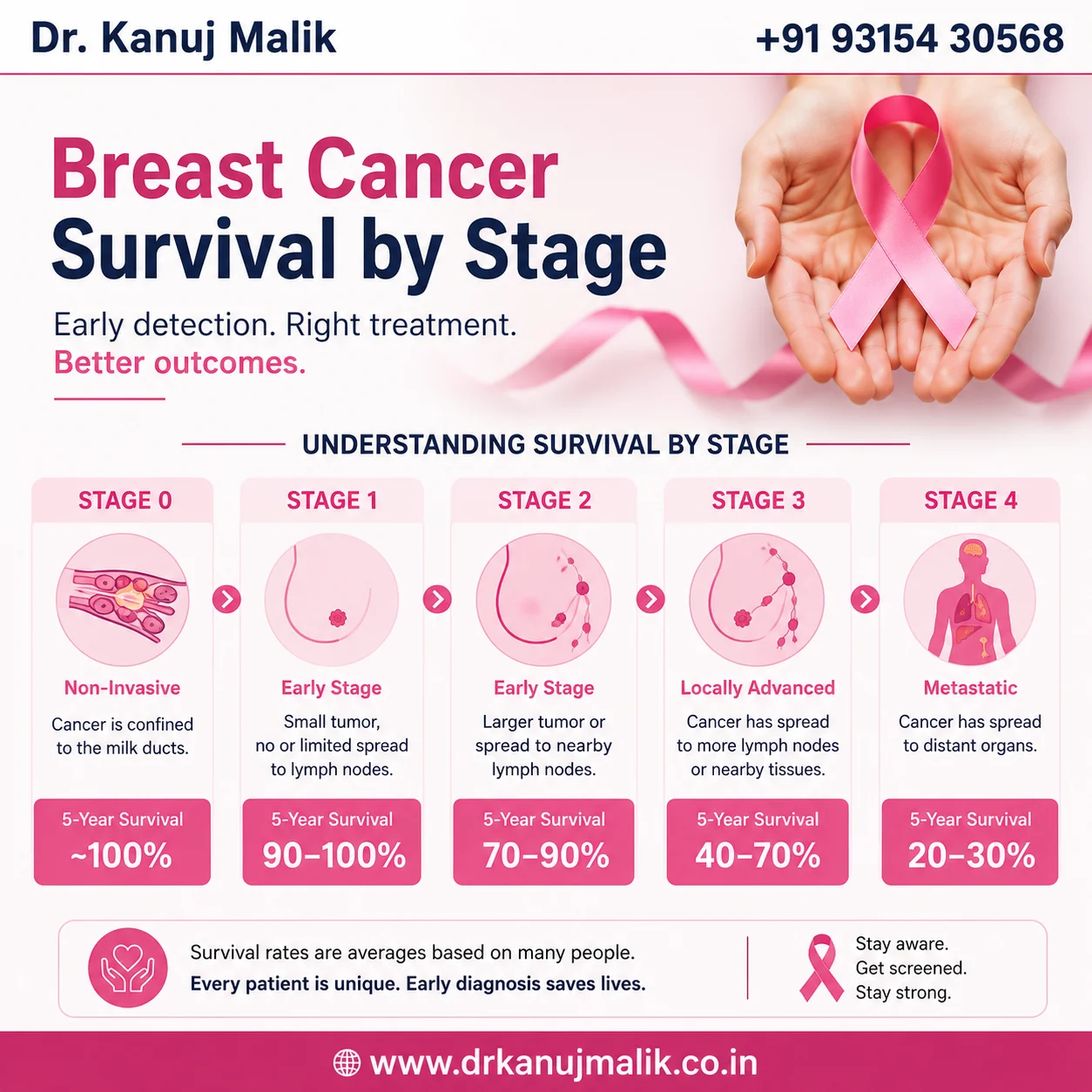
Breast Cancer Survival by Stage at a Glance
| Stage | Cancer Spread | General Outlook |
|---|---|---|
| Stage 0 | Confined to milk ducts | Excellent prognosis with treatment |
| Stage 1 | Small tumour inside the breast | Very high long-term survival |
| Stage 2 | Larger tumour or limited lymph node involvement | High survival with timely treatment |
| Stage 3 | Extensive lymph node involvement or nearby tissues | Good outcomes are possible with combined treatment |
| Stage 4 | Spread to distant organs | Long-term disease control is possible in many patients |
Stage 0 Breast Cancer Survival
Stage 0 breast cancer is also called ductal carcinoma in situ (DCIS). The abnormal cells remain inside the milk ducts and have not invaded nearby breast tissue.
Most patients diagnosed at this stage have an excellent outlook after appropriate treatment. Surgery, with or without radiation therapy, is commonly recommended. Regular follow-up remains important.
Stage 1 Breast Cancer Survival
Stage 1 breast cancer is an early-stage invasive cancer. The tumour is usually small and may not have spread beyond a few nearby lymph nodes.
Breast cancer survival by stage is highest for Stage 1 because treatment begins before extensive spread occurs. Depending on tumour biology, treatment may include surgery, radiation therapy, hormone therapy, chemotherapy, or targeted therapy.
Many patients return to their normal daily activities after completing treatment.
Stage 2 Breast Cancer Survival
Stage 2 breast cancer may involve a larger tumour or limited lymph node involvement. Even at this stage, treatment can be highly effective.
Doctors usually recommend a personalised treatment plan. This may include surgery, chemotherapy, radiation therapy, hormone therapy, or targeted medicines based on the tumour subtype.
Learning about targeted therapy in breast cancer can help patients understand how modern treatments improve outcomes.
Stage 3 Breast Cancer Survival
Stage 3 breast cancer is known as locally advanced breast cancer. The disease may involve multiple lymph nodes or nearby tissues, but it has not spread to distant organs.
Treatment often combines chemotherapy, surgery, radiation therapy, and targeted treatment. Many patients achieve complete remission after comprehensive care.
Breast cancer survival by stage has improved for Stage 3 because treatment strategies continue to evolve.
Stage 4 Breast Cancer Survival
Stage 4 breast cancer is metastatic breast cancer. It means cancer has spread to organs such as the bones, liver, lungs, or brain.
Although Stage 4 is not usually considered curable, many patients live for years with modern treatment. The focus is on controlling cancer, reducing symptoms, and maintaining quality of life.
Newer targeted therapies, immunotherapy, and personalised treatment plans continue to improve long-term disease management.
Survival Rate vs Prognosis
These two terms are often confused.
Survival rate is based on data collected from large groups of patients.
Prognosis is an individual doctor’s assessment based on your specific condition.
Two people with the same stage may have different outcomes because every cancer behaves differently.
Factors That Affect Breast Cancer Survival
Breast cancer survival by stage is only one part of the picture. Several other factors influence treatment outcomes.
- Age and general health
- Tumour size
- Lymph node involvement
- Hormone receptor status
- HER2 status
- Triple-negative breast cancer subtype
- Genetic mutations such as BRCA
- Response to treatment
- Early diagnosis
- Completion of the recommended treatment plan
Patients with HER2-positive breast cancer and those diagnosed with triple-negative breast cancer may require different treatment strategies because these subtypes behave differently.
How Modern Treatments Have Improved Breast Cancer Survival
Breast cancer treatment has advanced significantly. Today, many patients have better outcomes than in the past. Treatment is tailored to the type and stage of the disease.
- Breast-conserving surgery
- Targeted therapy
- Hormone therapy
- Immunotherapy for selected patients
- Advanced radiation techniques
- Personalized treatment planning
Recent advances in breast cancer surgery techniques have also helped improve recovery and treatment outcomes.
Why Early Detection Improves Survival
Early diagnosis gives doctors more treatment options. It also reduces the chance of cancer spreading to distant organs.
Do not ignore a new breast lump, nipple discharge, skin changes, or persistent breast pain. Regular screening and prompt evaluation can make a meaningful difference.
Women should also understand the importance of regular mammograms and learn how to perform breast self-examination at home.
Healthy Habits That Support Better Outcomes
Medical treatment is the most important part of breast cancer care. Healthy lifestyle choices can support overall well-being during and after treatment.
- Maintain a healthy weight.
- Stay physically active.
- Eat a balanced diet.
- Avoid tobacco.
- Limit alcohol intake.
- Take medicines as prescribed.
- Attend all follow-up appointments.
- Manage stress and get adequate sleep.
Simple lifestyle changes may also help lower future cancer risk. Learn more about lifestyle changes to reduce breast cancer risk.
Common Myths About Breast Cancer Survival
Myth 1: Stage 4 breast cancer means immediate death.
Fact: Many people live for years with metastatic breast cancer because of modern treatment options.
Myth 2: A 5-year survival rate means life ends after five years.
Fact: The five-year survival rate is a statistical measure. Many patients live much longer.
Myth 3: Every patient with the same stage has the same outcome.
Fact: Survival depends on tumour biology, treatment response, and overall health.
Understanding the facts is important. You can also read about common myths about breast cancer.
When Should You Consult an Oncologist?
Consult a cancer specialist if you notice:
- A new breast lump.
- Bloody nipple discharge.
- Skin dimpling.
- Nipple inversion.
- Swelling in the underarm.
- A breast symptom that does not improve.
Early consultation allows timely diagnosis and treatment planning.
About Dr. Kanuj Malik
Dr. Kanuj Malik is a Surgical Oncologist who manages breast cancer and other solid tumours using evidence-based treatment approaches. Every treatment plan is personalised after evaluating the cancer stage, imaging findings, biopsy results, and the patient’s overall health.
Dr. Kanuj Malik
Phone: 09315430568
Address: Shop No. 143, 1st Floor, Cleo Street, Near CLEO County, Sector 121, Noida, Basi Bahuddin Nagar, Uttar Pradesh 201301
Location: View on Google Maps
If you are looking for a Breast Cancer Specialist in Noida or want to consult a Surgical Oncologist, seek medical advice promptly if you have concerning symptoms.
Frequently Asked Questions
Can breast cancer be cured if diagnosed early?
Many early-stage breast cancers can be treated successfully. Early diagnosis improves treatment options and long-term outcomes.
Which stage has the best survival?
Stage 0 and Stage 1 generally have the most favourable outlook because the cancer is detected before extensive spread.
Can Stage 3 breast cancer be treated successfully?
Yes. Many patients respond well to a combination of surgery, chemotherapy, radiation therapy, hormone therapy, or targeted therapy.
Is Stage 4 breast cancer always fatal?
Stage 4 breast cancer is considered advanced. However, many patients achieve long-term disease control with modern therapies.
Does breast cancer subtype affect survival?
Yes. Hormone receptor status, HER2 status, tumour grade, and genetic factors all influence treatment decisions and prognosis.
Conclusion
Breast cancer survival by stage provides useful information, but it is only one part of the overall picture. Your prognosis also depends on tumour biology, overall health, and response to treatment.
Early diagnosis, evidence-based treatment, and regular follow-up continue to improve outcomes for many patients. If you notice any concerning breast changes, seek evaluation from a qualified cancer specialist without delay.